7:30am
Account Name: 17thsoulja.8
Topic: California’s Homebuyer Program for Undocumented Immigrants
On Sundays, I usually wake up at 7AM since my kids don’t have to be at school. I have more time to run errands and scroll social media. A friend of mine private messaged me a video from blogger 17thsoula.8. I typically look at the account’s followers and engagement after watching videos. This post featured a poll section stating: “You are not alone” or “I’m an immigrant and don’t pay taxes”. As a result, I was inclined to believe this individual might be politically connected or involved and that this post is an entire hoax. I found the post rather interesting, but the caption was misleading and led me to dig deeper. I went to Google to do some fact-checking and came across more information on the program. The post covers details on the program’s eligibility criteria, potential benefits for undocumented immigrants, reactions from various stakeholders, and discussions surrounding the broader political and social effects of this program in California.
9:30AM
ASU Canvas
Media Source: Fix the Photo

I checked Canvas for class assignments and Module readings as I was eating breakfast, and I found the “Fix the Photo” article about photo editing and manipulation. I was amazed to see the world’s first photo captured in 1826 using camera obscura. Over time, inventions like Kodak and Polaroid cameras made editing easier for everyone. Digital cameras in the 1970s made editing even simpler. Before Photoshop, editing photos was expensive and mainly for the rich and elite.
2:30PM
Media Source: The NY Post Online
Topic: Republican Billionaire’s Involvement in TikTok Controversy
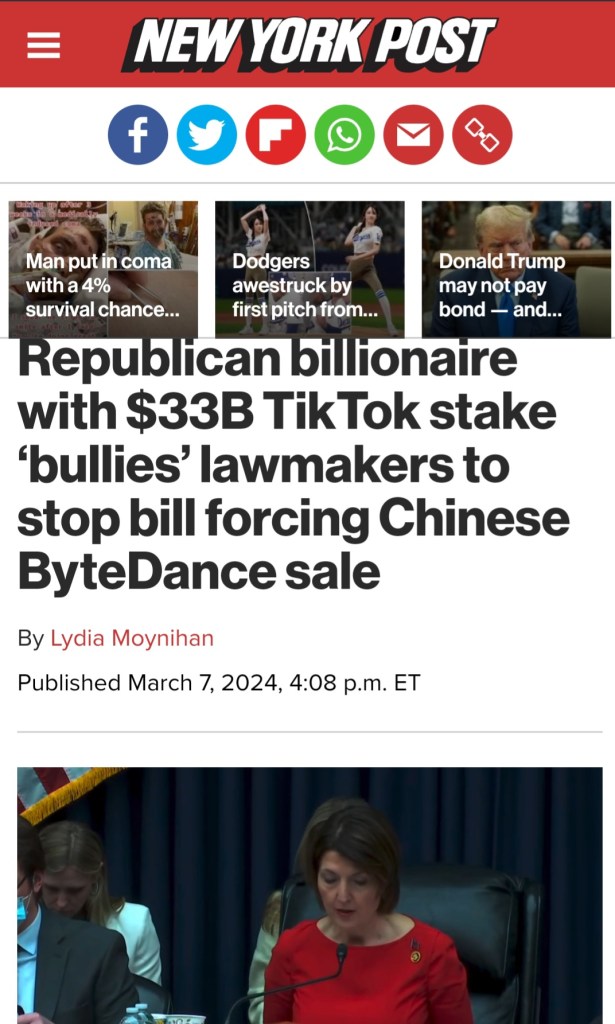
While at the park with my 10-year-old, I couldn’t help but overhear her discussing the TikTok ban with another child. It was surprising, considering they’re not even old enough to use the platform legally, but I decided to let it slide. Interestingly, they seemed to believe the ban stemmed from age restrictions.
Later, as I scrolled through Instagram, a notification from News Break appeared on my phone. The algorithm conveniently presented an article from The NY Post about the TikTok ban. Curious to learn more, I clicked on the link to gain further insight.
6:50PM
Account Name: Pubity
Topic: Jeff Bezos’ Ex-Wife’s Charitable Donation
Heading downstairs to grab my Amazon package, I thought it would be a routine trip. But as I hopped onto Canvas to tackle my weekly assignments, I stumbled upon a link to an Instagram post shared by my friend. When I clicked on the link, my face froze, and I was trying to decipher why she was sitting amidst stacks of cash while being adorned with gold chains. The comments were hysterical with one user stating that they identified as a non-profit. I was very tempted to leave a comment, but I logged off. Other users were outraged as to why she would be donating such a substantial amount of money to charity. I did some research and discovered that Mackenzie Scott, Jeff Bezos’ ex-wife and Amazon co-founder, continues to donate generously to nonprofit groups across the country as part of the Giving Pledge. These donations, ranging from $1 million to $2 million, support various causes such as the arts, affordable housing, education, public health, immigration, and diversity. Seeing Bezos’s ex-wife looking like a rapper was hysterical and that was enough social media for the day.
View the Instagram post featuring Jeff Bezos’ ex-wife with wads of cash and the caption stating her intention to donate $640 million to non-profits.
In the media diet presented, I encountered a mix of content ranging from potentially questionable to factual. The content shared by friends and influencers on social media platforms seemed to prompt me to fact-check more often, as it’s essential to verify information from unfamiliar sources. I came to several conclusions based on the nature of the information and its sources. When presented with a video from a friend discussing California’s Homebuyer Program for Undocumented Immigrants, I noticed potential political bias, prompting me to fact-check the information for accuracy and gain a more balanced understanding of the topic.
While some content appeared exaggerated, others provided valuable insights into current events and topics of interest. Upon receiving a notification about a TikTok ban article from The NY Post, I observed a potential for sensationalized reporting, leading me to read the article to discern any underlying biases or motivations.
Lastly, encountering an Instagram post featuring Jeff Bezos’ ex-wife surrounded by cash and claiming a charitable donation, I recognized the potential for sensationalism and opted not to engage further, prioritizing critical thinking and responsible media consumption.
Regarding patterns or trends, I noticed that certain individuals or outlets seemed to share content with a particular bias or agenda. For instance, the blogger discussing the California Homebuyer Program for Undocumented Immigrants may have had a political affiliation influencing their presentation of the topic. Similarly, the article about the Republican billionaire’s involvement in the TikTok controversy could have been framed to align with a specific narrative. Recognizing these potential biases prompted me to conduct fact-checking to ensure I obtained a balanced perspective.
These conclusions guided me to fact-check information from different places and be careful about getting involved with anything that might not be completely true. This helps me make sure I’m getting reliable information and not falling gullible to misleading information. It’s important to stay critical and check different sources to understand what’s going on in today’s media landscape.

 PM Says