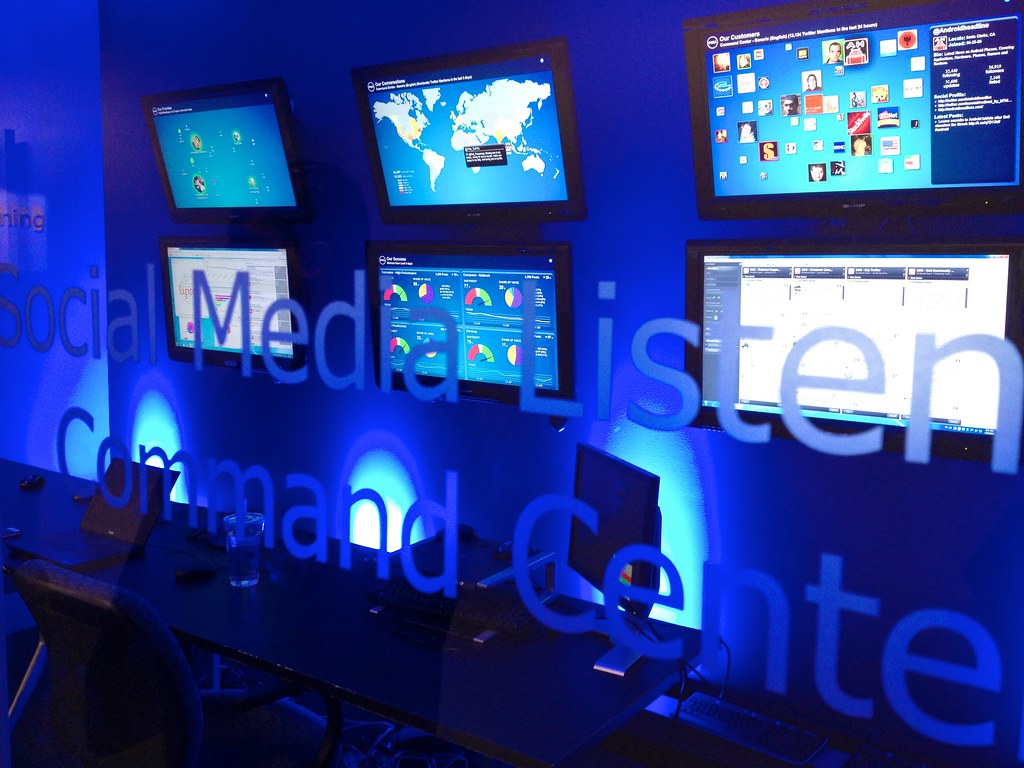
Photo Credit: Dell’s Social Media Listening and Command Center by Geoff Livingston
In this blog post, we’ll discuss how different sectors deal with free expression issues. From social media platforms to policymakers, each has its own pros and cons when it comes to protecting free speech.
Private Internet Companies
Social media companies, like Facebook and Twitter, can help people express themselves online. But they also control what we see and can censor content. They need to be clear about their rules and not censor too much. Facebook and Twitter serve as dynamic platforms that empower individuals to express themselves in various ways. Users can share personal stories, experiences, and opinions with their friends and followers, fostering connections and building communities based on shared interests or experiences. Additionally, these platforms enable users to raise awareness about important issues and causes by sharing news articles, videos, and infographics. Through the use of hashtags and events, users can organize and promote rallies, protests, and other events, facilitating real-world activism and social change.
On the flipside, the ability to organize rallies and protests through hashtags and events on social media platforms can present several potential challenges for users. Firstly, there’s the risk of surveillance and monitoring by governments or other entities, which may lead to individuals being tracked and targeted for expressing dissenting opinions or participating in activism. Users involved in organizing or participating in rallies may face targeted harassment or intimidation from individuals or groups opposed to their cause, both online and potentially in the physical realm. Social media platforms may also enforce censorship or remove content related to rallies or protests if they deem it to violate their community guidelines or terms of service, potentially limiting users’ ability to organize and communicate about important social or political issues. The open nature of social media allows for the rapid spread of misinformation and disinformation, which could undermine the goals or credibility of rallies or protests, leading to confusion or mistrust among participants.
Additionally, Facebook and Twitter provide spaces for creative expression, allowing artists and creators to showcase their work and connect with audiences. These platforms facilitate public discussions and debates, allowing users to engage with others, share their perspectives, and participate in meaningful dialogue on a wide range of topics. Overall, Facebook and Twitter play a crucial role in enabling individuals to express themselves, connect with others, and engage in public discourse. Although social media can be a powerful tool for activism and social change, users must be aware of these risks and challenges and take appropriate precautions.
According to Jack Balkin, social media also lacks incentives to prioritize trustworthiness in fostering a healthy digital public sphere. Current models prioritize profit through advertising and data surveillance, leading to issues like misinformation and polarization. Dominance by a few major platforms stifles competition, undermines journalism, and enables surveillance capitalism. Diverse social media ecosystems are crucial to mitigate these issues and prevent monopolization of data and influence.
Government and Policymaking:
Governments make rules about what we can say online. Sometimes these rules protect us, but they can also limit our freedom. Government and policymaking entities have the pivotal role of enacting legislation to protect free expression rights and ensure access to information. Additionally, they provide oversight and regulation to foster fair and equitable expression. However, there are risks of overreach that could lead to censorship or privacy infringements, as well as the politicization of speech regulations, threatening free expression.
The Jan. 6 insurrection and online speech regulations both touch on the balance between freedom of expression and government oversight. While regulations aim to protect individuals and ensure fair expression, there’s a risk of overreach leading to censorship or politicization of speech rules that was touched upon in Freedom Forum. This highlights the delicate balance between protecting free expression and preventing harm, emphasizing the potential pitfalls of government intervention in regulating online speech.
To safeguard free expression, it’s important for these entities to uphold constitutional protections while addressing emerging digital-age challenges and collaborate with other sectors to develop effective policies. One example of this is the development of net neutrality regulations. Net neutrality ensures that internet service providers treat all data on the internet equally, without discriminating or charging differently based on user, content, website, platform, application, or method of communication. In upholding constitutional protections, policymakers can ensure that net neutrality regulations align with principles of free speech and expression, preventing ISPs from blocking or throttling access to certain websites or services based on their content. They must also remain vigilant against regulatory capture by powerful interests and enact legislation that fosters innovation and protects legitimate expression.
Civil Society and Third-Party Researchers:
Groups outside the government and companies watch over what they do. They help us understand what’s happening online. But sometimes they don’t have enough resources to do their job well. Civil society and third-party researchers play a crucial role in advocating for free expression rights and holding governments and corporations accountable. Their research efforts help understand speech trends and identify threats to expression. However, they face challenges such as limited resources and influence compared to larger entities and the risk of biases in their methodologies or advocacy agendas. To safeguard free expression, collaboration with other sectors is crucial to amplify voices and advocate for change. They should offer expertise and analysis to shape policy debates and public discourse, ensuring marginalized voices are represented and maintaining transparency in funding to preserve independence.
Media and the News Industry:
News organizations tell us what’s happening in the world. But sometimes they don’t tell the whole truth or focus too much on things that already get enough attention. The media and news industry serve as watchdogs, holding power to account and facilitating informed public debate by providing platforms for diverse viewpoints and expression. However, challenges include consolidation of media ownership limiting diversity of perspectives, and pressures to prioritize sensationalism or partisan narratives over factual reporting. To safeguard free expression, commitment to journalistic ethics and standards is essential to ensure accuracy and fairness. Investing in media literacy initiatives empowers audiences to critically evaluate information.
Each sector needs to work together and be careful not to limit free expression too much. By being transparent and fair, we can protect our right to speak freely online. In this digital era where free expression is at an all-time high, private internet companies should ensure transparent content moderation and empower users. Governments must uphold free speech while collaborating for inclusive policies. Civil society and researchers should amplify diverse voices and ensure funding transparency. Media must uphold standards, invest in literacy, and guard against polarization and economic pressures.

 PM Says
Leave a comment