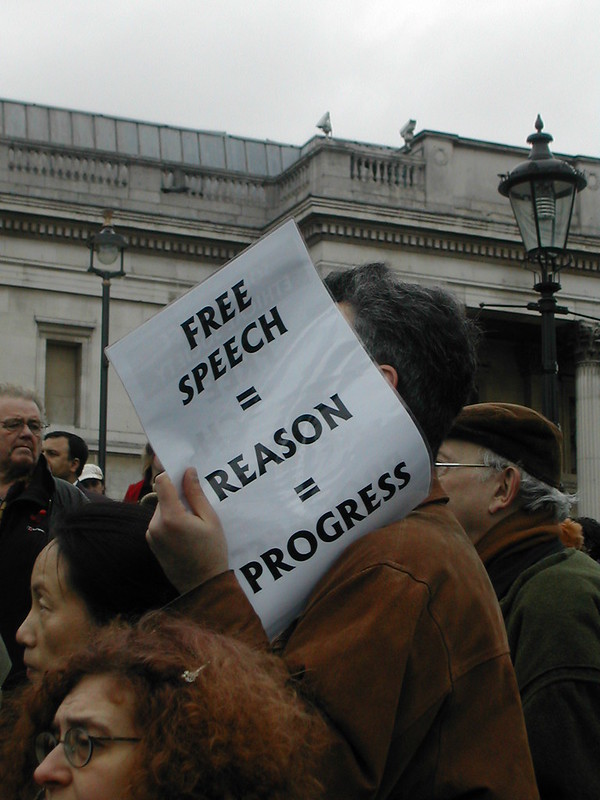
Photo Credit: Simon Gibbs
The idea of free expression has a big impact on how society functions, affecting both public and personal aspects of our lives. In public, it’s a crucial part of keeping democratic principles strong. Drawing inspiration from the work of Foucault in “The Meaning and Evolution of the Word Parrhesia”, the argument unfolds that the unrestricted articulation of opinions, even those divergent or contentious, is indispensable. This suggests that parrhesia and freedom of speech are about advocating for straightforward and transparent communication, deeming it essential for a society that’s both resilient and well-informed. Essentially, it is about having faith in the strength of open and unfiltered conversations, where folks can freely exchange ideas and perspectives without being hindered by outside pressures or restrictions.
Expressing yourself freely is like a channel for diving deep into your thoughts and fine-tuning them. Unlike isegoria, however, parrhesia was equally at home outside of the ekklesia, in more and less informal settings. Take the theater, for example, where playwrights like Aristophanes didn’t hold back, mocking fellow citizens, including Socrates, by name. However, the real parrhesiasts in ancient times were the philosophers, those self-proclaimed ‘lovers of wisdom’ like Socrates.
One particularly famous example mentioned in Two Concepts of Freedom of Speech, was Diogenes the Cynic, who gained notoriety for unconventional behavior such as residing in a barrel, engaging in public acts that today might be deemed inappropriate, and even instructing Alexander the Great to step aside from his sunlight—reportedly, all these actions were his way of shedding light on the arbitrary nature of Greek customs. It’s important to recognize that what may be considered inappropriate today might be understood differently when viewed through the lens of evolving cultural norms and changing expressions over time.
Protecting free speech is crucial because it supports democracy by allowing different perspectives and prevents everyone from thinking the same. Free speech empowers individuals to voice their concerns, share their experiences, and contribute to public discourse. This empowerment is crucial for personal development and a sense of belonging in society. Foucault mentions that the freedom to speak openly in ‘democratic parrhesia‘ is granted to those considered the best citizens, but this privilege gets shaky when the revealed truth challenges the majority, risking exile or suppression.
The institutional backdrop of ‘democratic parrhesia’ highlights the fragile balance between free expression and safeguarding established norms, emphasizing the vulnerability of truth in the face of prevailing power structures. Through open dialogue, societies can address and rectify social injustices. Free speech serves as a tool for advocating change, challenging the status quo, and promoting equality. As a result, finding the right balance between expressing freely and adhering to societal norms is complicated.
In today’s digital world where everyone’s connected, an interesting piece from Films for the Feminist Classroom, expresses how online spaces help build our digital selves. Video games are robust forms of expression, merging design, code, art, and sound that can offer immersive classroom interaction. Universities and academic institutions are also spaces where free expression is essential. Scholars and students engage in open dialogue, challenging established ideas and contributing to the growth of knowledge particularly with weekly discussions. This allows individuals to create stories that showcase their beliefs, values, and experiences, playing a big role in how we see ourselves and others.
It’s important to think carefully, making sure that free expression and societal norms can work together smoothly for a genuine democratic conversation. A crucial inquiry to consider is: How can we proactively maintain and strengthen the equilibrium between free expression and established norms, ensuring that diverse perspectives thrive in our democratic society?
In the ongoing discussion, people agree that in democracies, the challenge isn’t the government but the influence of fellow citizens, often seen as a ‘social tyranny.’ Those on the Left, supporting ‘no-platforming’ to block objectionable views in public, claim they’re not against free speech. They focus on preventing harm from hateful speech to vulnerable groups. They draw ideas from feminist thinkers and critical race theorists from the 1990s, influenced by J. L. Austin’s theory of speech acts. For them, limiting platforms for historically privileged voices is crucial for equal speech rights, giving a voice to the most marginalized in society.
In conclusion, the importance of free expression is complex, covering both public and personal areas. It’s a key element for democratic societies, encouraging diverse thinking, and at the same time, aiding in shaping personal identity. The need to protect free expression is highlighted by its role in supporting democratic principles, balancing power, and promoting individual freedom.

 PM Says
Leave a comment